

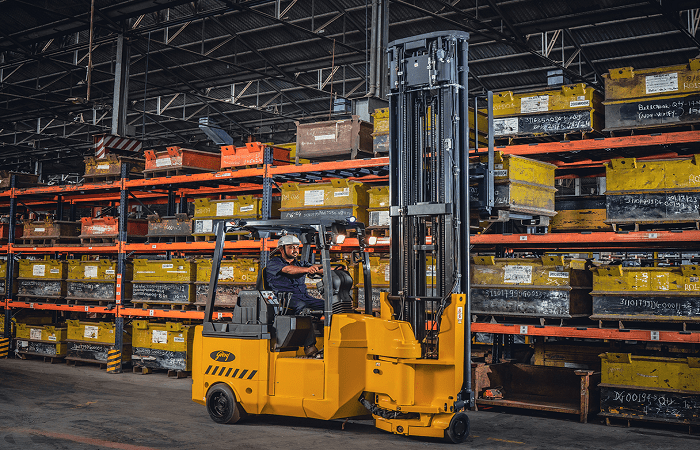
In high-density warehouses that are so common today, going vertical isn’t just a choice; it’s a necessity. Especially in Indian cities where space is always at a premium, warehouse operators are having to make the most of every square foot. That means higher racking systems, narrower aisles, and a growing need for machines that can reach, lift, and turn, all without wasting time or space. This is where articulated forklift rental makes perfect sense.
These machines aren’t like the average forklift. The mast on an articulated forklift swivels independently while the truck stays in position, which lets operators reach loads without turning the entire vehicle. That one change makes a big difference when you’re working with tight aisle widths and shelves stacked 12.5 metres high. For any warehouse manager trying to find the right balance between cost, flexibility and space optimisation, renting an articulated forklift offers a smart, scalable option.
What is an Articulated Forklift and How Does It Work?
Unlike standard counterbalance forklifts, articulated forklifts are built keeping agility in mind. They are so named because of the “articulated” joint that allows the mast to move from side to side. Instead of repositioning the entire truck, the operator can stay still and simply swing the mast into the correct aisle position. That saves time, reduces wear on the tyres, and lets drivers operate in narrower lanes.
You’ll hear people also refer to these as very narrow aisle forklifts or VNA trucks. That’s because they’re typically used in racking setups where aisle width is squeezed to its minimum, sometimes just over 2 metres. In traditional setups, that kind of configuration would mean constant reversing and re-angling, but articulated forklifts cut that complexity out of the equation.
These machines are powered electrically, which is ideal for indoor settings like warehouses. But what really sets them apart is the reach. With lift heights going up to 12.5 metres and a capacity of around 2 tonnes, they’re built to handle both bulk and height.
Why Forklift Rental Service Is Better Than Buying
In the Indian warehousing sector, speed is very important, but so is cost control. Buying a high-reach forklift outright means upfront investment, ongoing maintenance, operator training, and eventual replacement. For many warehouse operators, that math doesn’t add up.
That’s where a forklift rental service comes in very useful. Renting eliminates the capital cost (shifting it to operational cost), gives you access to the latest models, and often includes operator and maintenance support.
For example, a warehouse in Bhiwandi that only handles high-reach inventory during festive seasons doesn’t need to own an articulated forklift year-round.
Technical Specifications That Matter on the Ground
If you’re operating in a high-bay warehouse or setting up narrow aisle racking, these are the specs that actually make a difference:
| Specification | Details |
| Lifting Capacity | Up to 2 tonnes |
| Power Source | Electric |
| Max Fork Height (MFH) | Up to 12.5 metres |
| Minimum Aisle Width | Around 2.15 metres |
These numbers may not mean much on paper, but in practice, they’re what allow warehouse managers to rethink how their space is laid out. If your aisles can be narrowed, your racking height increased, and your goods still picked up without repositioning the forklift every time, that’s a lot of efficiency added to the operations.
Features That Solve Everyday Problems
Warehouse operations aren’t theoretical. They’re messy, fast-paced, and always changing. What makes articulated forklifts so well-suited to Indian warehouses is how they’ve been designed to handle that chaos.
- Tall mast reach:Up to 12.5 metres to access top racks.
- Side shifters:Make precise pallet positioning easier without moving the vehicle.
- Battery rollout system:Perfect for 24×7 operations—just replace and go.
- Adjustable forks and overhead guards:Handles different pallet types safely.
- Onboard cameras and monitors:Give the operator better visibility, especially at height.
- USB ports and biometric access:Small features that improve operator experience and security.
Some rental providers, like Godrej RenTRUST, also include options like maintenance, flexible terms, and even a provision to outsource skilled operators. That removes a lot of the managing hassles from your end and keeps downtime to a minimum.
Choosing the Right Forklift Rental Partner
Not all rental partners offer the same depth. Some just hand over the equipment. Others go a step further, with on-site service, operator support, and layout consulting. The latter is what you want if you’re scaling warehouse ops across regions.
For example, companies like Godrej RenTRUST provide flexible rental contracts that are well-suited for different project timelines, seasonal volume of work, or geographic locations. What matters is the backup support. You don’t want a supply chain waiting on a battery fix. Ask for response time SLAs. Check if they offer replacement units.
Final Thoughts
The Indian warehousing sector is evolving quickly. High land prices, faster inventory turns, and demand for better efficiency mean that old equipment strategies no longer work. In this context, articulated forklift rental is less about short-term savings and more about long-term adaptability.
Whether you’re reworking your aisle widths, expanding into new formats, or simply trying to stay lean without compromising on throughput, renting gives you the operational headroom you need, without the financial drag of asset ownership.
As warehouses continue to go vertical and floor layouts become more complex, the question no longer is whether you should rent. It’s how soon can you start?