

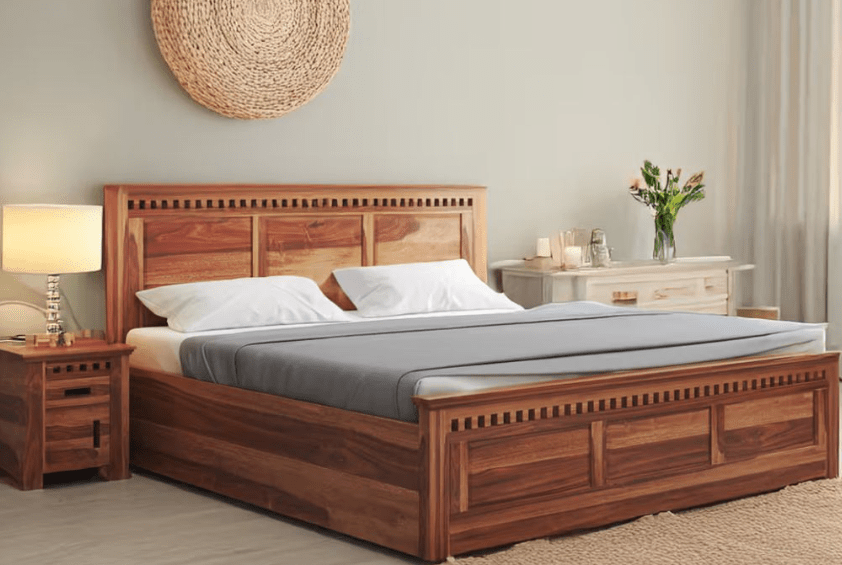
The right bed depends on who sleeps in it, what size room it goes into, and whether you rent or own. A 1BHK renter in Bengaluru who moves every two years needs a different answer than a family setting up a senior parent’s room in a 3BHK – even at the same Rs. 25,000 budget. This guide gives you the decision framework by life stage, room size, and Indian climate reality – before you start browsing.
Why do most bed buying guides miss the mark for Indian buyers?
Every bed guide covers the same ground: sizes in inches, storage types, solid wood vs. engineered wood. What they don’t address is the actual range of situations Indian buyers are in. A large share of metro buyers are renters who will move the bed twice before it is five years old. Many Indian households have co-sleeping as a default – parents with toddlers, grandparents in family bedrooms. And no guide answers the question of someone who already has a mattress and just needs the right frame for it.
Standard guides also treat all Indian cities as identical. A bed that holds up fine in Bengaluru’s moderate climate behaves differently in Mumbai’s year-round humidity or Delhi’s dry winter cold. Material advice needs to be city-specific, not generic – and it rarely is. The result is that most buyers end up choosing on price and appearance, which are the two least predictive variables for long-term satisfaction.
What bed size actually fits your room and household in India?
| Room Size | BHK Type | Maximum Bed | For Couple | For Single or Guest |
| Under 100 sq ft | 1BHK or compact flat | Double (4.5 x 6 ft) | Double | Single |
| 100-130 sq ft | Standard 2BHK bedroom | Queen (5 x 6.5 ft) | Queen | Double |
| 130-160 sq ft | 2BHK master or 3BHK bedroom | King (6 x 6.5 ft) | King | Queen |
| 160 sq ft and above | 3BHK master | King or Super King | King | King |
The most common mistake is choosing a bed based on preference, not room clearance. A king in a 110 sq ft room means a corridor you turn sideways to walk through. Mark the footprint on your floor with tape, leave 2.5 ft on each walkable side, and confirm it works before buying. Also account for the side tables – a king bed with two side tables in a 120 sq ft room will leave almost no usable floor space on either side.
How should your life stage change which bed you buy?
| Life Stage | Recommended Type | Key Priority |
| 1BHK renter (moves every 2-3 years) | Simple platform or box frame, engineered plywood | Avoid hydraulic storage – gas pistons degrade with each full disassembly and reassembly |
| Newly married couple, planning a family | Queen or King, 18-22 inch height, solid headboard | Safe height for co-sleeping toddlers, no sharp corners, room to grow |
| Family with young children co-sleeping | Low platform or floor-level bed under 14 inches | Prevents roll-off injury, wide enough for three people |
| Setting up a senior parent’s room | Elevated bed 24-26 inches, simple frame no hydraulics | Easier to sit and stand from, no complex mechanisms requiring bending to operate |
| Already own a mattress, need just the frame | Any frame matching your mattress size exactly | Measure the mattress itself – queen sizing varies 2-4 inches across brands |
The co-sleeping situation is particularly India-specific. A significant proportion of Indian families share a bed with young children, either by choice or by space constraint. Standard beds at 20-24 inches height can result in fall injuries for children who roll during sleep. A low-platform bed under 14 inches removes this risk – and the height can always be raised on risers once the children are old enough to sleep separately.
What happens to bed frame materials in different Indian cities?
Climate is the most under-addressed variable in Indian bed buying advice. The same engineered wood that holds up in Bengaluru will swell and delaminate within three years in a coastal Mumbai flat. The failure is not gradual – it typically shows up in year two as stuck drawer mechanisms, warped back panels, and joints that no longer sit flush.
| City or Region | Climate | Avoid | Recommended |
| Mumbai, Chennai, Kochi, Goa | Coastal humid year-round | Bare MDF (swells at joints), untreated iron (rusts in salt air) | Marine plywood or solid sheesham with sealed finish |
| Delhi, Jaipur, Lucknow | Dry heat summers, cold dry winters | Unfinished teak or mango (surface cracks in cold) | Sheesham, well-lacquered engineered plywood |
| Bengaluru, Pune, Hyderabad | Moderate, seasonal humidity | Basic MDF without laminate | Laminate-finished engineered plywood or sheesham |
| Kolkata, Northeast India | High humidity, heavy monsoon | MDF of any grade | Pre-laminated board or solid wood with teak oil, powder-coated metal |
Termite risk is a separate variable that most guides ignore entirely. Ground-floor apartments and older buildings in humid states have meaningful termite risk. Solid wood beds in these environments need annual termite treatment. Engineered wood (plywood and MDF) does not attract termites because the adhesive binders are synthetic – a practical advantage that is rarely mentioned.
What is the real cost of owning a bed over 8 years?
A Rs. 15,000 bed that warps and needs replacing in 4 years costs Rs. 3,750 per year. A Rs. 55,000 solid wood bed lasting 20 years costs Rs. 2,750 per year – and has resale value. The math is not about spending more. It is about matching material to climate so replacement cycles do not eat the savings. The calculation changes further when you factor in the mattress: most good mattresses last 7-10 years, and replacing a bed mid-mattress-cycle means two purchases instead of one.
| Bed Type | Price Range | Expected Lifespan | Annual Cost |
| Basic MDF, no laminate | Rs. 10,000-15,000 | 2-4 years (humidity-dependent) | Rs. 2,500-7,500 |
| Laminate-finished engineered wood | Rs. 18,000-30,000 | 5-8 years | Rs. 2,250-6,000 |
| Plywood with solid wood accents | Rs. 28,000-45,000 | 8-12 years | Rs. 2,330-5,600 |
| Solid sheesham or teak | Rs. 45,000-90,000 | 15-25 years | Rs. 1,800-6,000 |
What should renters in Indian metro cities know before buying a bed?
Hydraulic storage beds are the worst option for renters. Gas pistons degrade noticeably each time the bed is fully disassembled and reassembled – which happens at every move. After two relocations, a hydraulic bed that once opened smoothly will be stiff, partially functional, or broken. The mechanism cannot be economically repaired once the pistons fail.
For renters: choose a platform frame with detachable legs in laminate-finished engineered plywood, in a queen size. This configuration survives moves without functional loss, fits most standard Indian bedroom layouts, and costs significantly less to replace if necessary. Avoid upholstered beds entirely as a renter – fabric headboards accumulate dust and stains that are impossible to clean properly, and their value drops sharply at resale.
What should you check when buying a bed online in India?
Online bed listings are where the material confusion is worst. ‘Solid wood’ in many listings means a solid wood veneer over an MDF or plywood core – technically accurate but misleading about durability. Ask the seller or check the product description specifically for the core material, not just the surface.
Also verify: the gas lift piston rating for hydraulic beds (cheap pistons fail at 80-100 kg load; look for 100-150 kg rated), the slat spacing (under 3 inches prevents mattress sag), and whether the assembly is included in the delivery or chargeable separately. Many mid-range bed brands charge Rs. 500-1,500 for assembly as an add-on. Confirm this before ordering so there are no surprises at delivery.
Which bed size is worth considering for a master bedroom?
For master bedrooms in 2BHK or 3BHK layouts where two adults need full sleeping width, a king size bed is the standard recommendation. The width difference between queen (5 ft) and king (6 ft) matters every night – and in rooms above 130 sq ft, the clearance math works out correctly for both walking space and bed size.