

The generative AI revolution has moved beyond static images. We have entered the era of “prompt-to-cinema,” where typing a sentence can summon a blockbuster scene. However, with the rapid evolution of technology, creators are facing a new dilemma: Choice Paralysis. Three major models have emerged as the leaders of the pack, each claiming the throne of the best AI video generator.
In this definitive guide, we analyze the strengths and weaknesses of the industry’s heavyweights to help you decide which tool deserves your attention. We will dive deep into the battle of Sora 2 vs Veo 3.1 vs Kling 2.5 and reveal why the smartest workflow isn’t choosing just one, but leveraging the power of all three.
The Comparison: Sora 2 vs. Veo 3.1 vs. Kling 2.5
To understand these models, we must look beyond the marketing hype. While they all generate video from text, their underlying architectures and “philosophies” differ significantly.
-
Sora 2: The Physics Engine & World Simulator
OpenAI’s Sora 2 is not just a video generator; it is built as a “world simulator.” Its primary strength lies in its deep understanding of physical laws and object permanence.
- 3D Space Consistency: Unlike earlier models that treated video as a sequence of morphing 2D images, Sora 2 understands 3D geometry. If the camera pans around a building, the back of the building remains consistent. If a character walks behind a pillar, they re-emerge at the correct speed and trajectory.
- Complex Interactions: Sora 2 excels at prompt complexity involving physics. Ask for a “glass of red wine shattering on a marble floor in slow motion,” and Sora 2 accurately calculates the fluid dynamics, the light refraction through the shards, and the stain spreading on the floor.
- The “Dream” Aesthetic: Sora 2 has a tendency toward hyper-realism that feels slightly elevated—perfect lighting, perfect skin textures, and cinematic color grading right out of the box. It is the go-to for high-end commercial visualization.
-
Veo 3.1: The Cinematic Director
Google DeepMind’s Veo 3.1 approaches generation from the perspective of a filmmaker. It prioritizes resolution, aspect ratio control, and temporal coherence over long durations.
- Resolution Supremacy: Veo 3.1 is currently the market leader in raw sharpness. It natively handles 1080p and 4K outputs with fewer compression artifacts than its competitors. For creators planning to display their work on large monitors or TVs, Veo 3.1 offers the cleanest image.
- Camera Language Mastery: Because it was trained on a massive dataset of cinematic content with detailed metadata, Veo 3.1 understands film terminology better than any other model. Prompts containing specific instructions like “dolly zoom,” “rack focus,” “dutch angle,” or “anamorphic lens flare” are executed with professional precision.
- Consistency Over Time: One of the biggest plagues of AI video is “hallucination” over time—where a shirt changes color or a face morphs after 5 seconds. Veo 3.1 has a robust context window that maintains subject identity for longer clips (up to 60 seconds+), making it ideal for narrative storytelling.
-
Kling 2.5: The Motion Master
Coming from Kuaishou, Kling 2.5 has surprised the Western market by often outperforming giants like OpenAI in specific motion dynamics, particularly regarding human movement.
- Human Biomechanics: The “Uncanny Valley” is most noticeable when AI humans try to walk, run, or eat. Kling 2.5 has a superior understanding of human skeletal structure. It generates fluid walking gaits, natural hand gestures, and complex interactions (like a hug or a handshake) with significantly fewer glitches than Sora 2.
- Speed and Efficiency: Kling 2.5 is built for speed. It allows for rapid prototyping, generating preview clips faster than the competition. This makes it a favorite for social media creators who need to churn out content quickly.
- Stylistic Flexibility: While Sora aims for photorealism, Kling 2.5 is surprisingly adept at stylized content. From 2D anime styles to 3D Pixar-like renders or claymation, Kling adapts to artistic prompts with high fidelity, making it a versatile tool for animators.
How to Choose the Right Model
With three incredible options, the question remains: “Which one should I use?” The answer depends entirely on your specific use case.
Choose Sora 2 If:
- You need VFX and Physics: Your scene involves water, fire, explosions, or complex object collisions.
- You are doing Product Visualization: You need hyper-realistic textures (leather, metal, glass) to showcase a product concept.
- You want “Out of the Box” Beauty: You don’t want to spend time color grading; you want the raw output to look like a high-budget commercial.
Choose Veo 3.1 If:
- You are a Narrative Filmmaker: You need your main character to look the same in Shot A as they do in Shot B.
- You need Precise Camera Control: You have a specific storyboard with technical camera moves that need to be followed strictly.
- You require High Definition: Your final destination is YouTube 4K or a film festival screen, not just a smartphone screen.
Choose Kling 2.5 If:
- You focus on People and Action: Your video features models walking, dancing, or performing sports.
- You are a Social Media Manager: You need fast turnaround times and content that grabs attention instantly on TikTok or Reels.
- You are an Animator: You want to experiment with non-photorealistic art styles and need a model that understands artistic nuance.
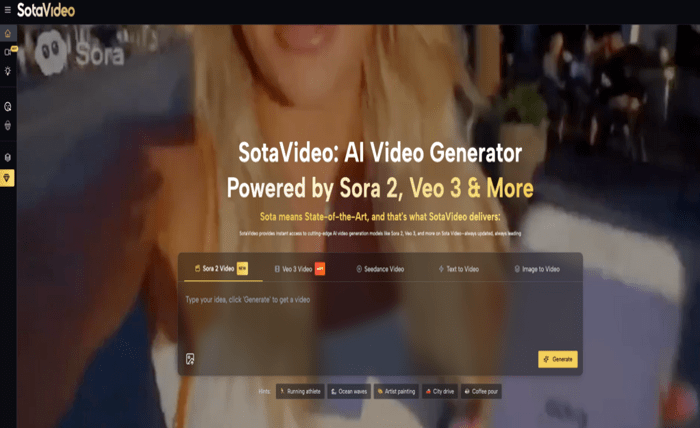
The Ultimate Solution: Use All of Them on SotaVideo
The debate of “Sora 2 vs. Veo 3.1 vs. Kling 2.5” usually leads to a frustrating financial reality. Subscribing to OpenAI’s premium tier, Google’s Workspace/DeepMind services, and Kling’s pro plan simultaneously could cost hundreds of dollars per month. Furthermore, managing three different accounts, three different credit balances, and three different interfaces kills the creative flow.
This is where SotaVideo.ai becomes the essential tool for the modern creator.
SotaVideo is an aggregation platform that unifies the world’s state-of-the-art (SOTA) video models into a single, streamlined dashboard. Instead of choosing a “camp,” SotaVideo allows you to be a diplomat of AI, utilizing the best technology for every single shot.
Why SotaVideo is the Superior Workflow:
- Cross-Model A/B Testing Prompt engineering is unpredictable. A prompt that fails on Sora might look incredible on Kling. On SotaVideo, you can enter your prompt once and generate variations across all three models simultaneously. This allows you to “cherry-pick” the best result. You might find that Veo handles your wide shots best, while Kling handles your close-up character shots best.
- Cost Efficiency Instead of paying for three separate expensive monthly subscriptions, SotaVideo typically operates on a unified credit system. You pay one price and spend your credits on whichever model you need at that moment. This drastically reduces the overhead for freelancers and small studios.
- Unified Interface Forget about learning the quirks of three different websites. SotaVideo standardizes the controls—aspect ratios, frame rates, negative prompts, and camera movements—so you have a consistent user experience regardless of which underlying engine is doing the heavy lifting.
- Future-Proofing The AI race is a marathon. Next month, a “Sora 3” or “Veo 4” might drop. If you are locked into a single annual subscription with one provider, you miss out. SotaVideo integrates new models as soon as they are released via API, ensuring you are always on the cutting edge of technology.
Conclusion
The battle between Sora 2, Veo 3.1, and Kling 2.5 proves that we are living in the golden age of AI video. Each model has carved out its own niche: Sora as the physics simulator, Veo as the cinematographer, and Kling as the motion specialist.
For the serious creator, the goal shouldn’t be to find the “one true model,” but to build a toolkit that includes them all. By utilizing a platform like SotaVideo.ai, you eliminate the boundaries between these technologies. You gain the freedom to choose the right engine for the right shot, ensuring your creativity is never limited by the capabilities of a single AI. The future of video isn’t about Sora or Veo or Kling—it’s about using them all in harmony.