


The Hindu pantheon is rich with narratives that weave a clear picture of all the Gods and Goddesses. There have been devastating wars and descriptive multiday battles, verbal spatters, even diplomatic differences in the Hindu epics, puranas, and Vedas that help us understand the weight of power each god holds. Though it is said the Hindu religion has 33 crore deities, there are certain ones which stand out for their show of might and wisdom. And this list brings you the most powerful of them.
These gods have been warriors, counsellors, creators, preservers, destroyers, and most important of all, sources of supreme power.
-
Lord Vishnu
Worshipped as the protector and the of the universe, Lord Vishnu is one of the most powerful gods in the Hindu legend. He is worshipped in many avatars, the most famous of
which are Lord Krishna and Lord Rama. It is said that whenever evil is on the brink of taking over, he descends down on the earth in a different avatar to restore balance. In the popular representations, he is depicted with blue skin and holding a mace, club, a discus, and a lotus in all four of his arms.
-
Lord Shiva
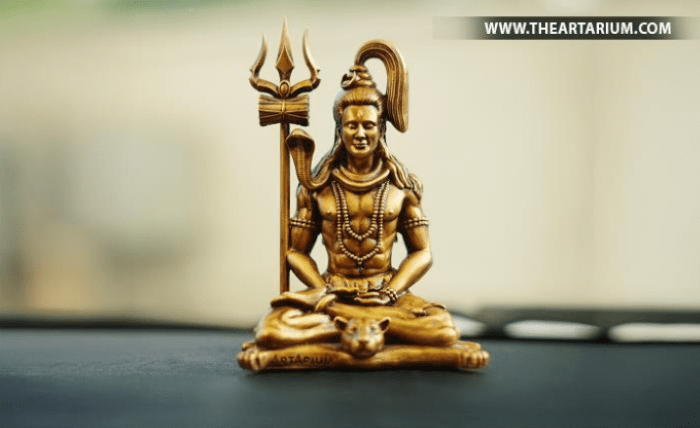
Lord Shiva is the manifestation of ultimate reality widely referred to as Mahakala, meaning the lord of time. He is the one who is in-charge of all the destruction in the universe and has been presented in many avatars throughout the Hindu legend – from benevolent ascetic and householder to the destroyer and other iconographic forms (like Nataraj, Ardhnarishvara, etc.). He is the eternal Brahman and is not imbued in the cycle of death and birth unlike other gods. His most popular form, that have been eternalized by Shiv Murtis all across the world, show him in a calm meditative pose with heavy flowing tresses and the Vasuki Naag around his neck.
-
Lord Brahma
Like Lord Vishnu and Lord Shiva who have their own roles in the cosmos, the role of Lord Brahma is to create. During the post-Vedic period, his relevance among the masses made him among the most worshipped deities. But he was soon overshadowed by other major gods. A story regarding why he is not worshipped today tells how he made Lord Shiva angry who removed one of his heads and cursed him that he will never have any followers.
Another way to see why Brahma is not worshipped is that his role as the creator is over and it is up to Lord Vishnu and Shiva to preserve and continue the path of reincarnation.
-
Shakti
Literally, Shakti translates to “power” itself and the deities that represent this concept are personified through various goddesses. In the gentle and benevolent form, Shakti is Uma or the mother and consort of Lord Shiva. In the warrior form, she is depicted as the Durga who fights against the forces that threaten the stability of the universe. And in the fiercest form, she is represented through Kali. Shakti’s influence is not limited to her own manifestations but also affect the deities in the Hindu religion.
-
Lord Krishna
While being one of the most famous avatars of Lord Vishnu and an important character of Mahabharata, Lord Krishna is also the most powerful gods in the Hindu legend. From a very early age he showed his might through various incidents, like lifting the Govardhan hill to protect his villagers from severe floods and defeating many powerful asuras.
However, his most prominent role was in the war of Mahabharata where he served as a counsellor to Arjuna. A whole scripture called Shri Bhagvat Gita recounts how the god shared his advice and a piece of his wisdom to Arjuna who was beginning to question the relevance of his duty.
-
Lord Ganesha
Lord Ganesha, with an elephant head and a human body, is one of the most celebrated gods in the Hindu religion. His adorable image has an interesting story behind it.
It is said that Goddess Parvati created Lord Ganesha out of sandalwood paste to guard her chambers as she bathed. However, in that very duration, Lord Shiva returned from the Himalayas after a long meditation and the little god denied him entry. This angered Shiva and he, in a fit of rage, chopped off the head of Ganesha. When Goddess Parvati came to realize what had happened, she was in great despair. So, to console his wife, Lord Shiva replaced the head of the child with that of an elephant.
Lord Ganesha symbolizes wisdom and is known as the remover of obstacles. In the legends, he is said to have gone toe-to-toe with Lord Parashuram and have won a race with his brother purely through intelligence.
On Ganesha Chaturthi, people celebrate the god by offering prayers to God Ganesh murti and submerge them in a body of water to represent the deity’s return to his heavenly home.
-
Lord Rama
There are many titles that sing the greatness of Lord Rama but the most famous one of them is Maryāda Puruṣottama Rama, the Ideal person. This is due to his many qualities that transcend him from the humans and make him a god. A few of those qualities were righteousness, justice, and courage.
He is the protagonist of the Ramayana, which tells the story of his exile for 14 years and how he fought the evil incarnate, Ravana, to protect his wife. The events of this epic are celebrated every year during the Hindu festival of Dussehra and Diwali.
-
Kartikeya
Kartikeya, also known as the Skanda, is the Hindu God of war who is also the son of Goddess Parvati and Lord Shiva. He is a symbol of strength, valor, and guardianship who was raised to fulfill his destiny of defeating the demon Taraka and protect the devas which makes him a powerful god in the Hindu religion.
In the popular depictions, he is seen as a youthful handsome man carrying a spear or a sword while his peacock, with his loyal vahana, a peacock by his side.
Conclusion
From the powerful trinity of Brahma, Vishnu, and Shiva, to the warriors like Lord Rama and Kartikeya, these deities are worshipped for their divine strength and wisdom. Not only are they an inspiration to us, but all gods teach us to lead better lives with courage and integrity.